
Major Spoilers Ahead
Before I begin, I want to make it explicitly clear that I never wanted The Last of Us 2 to fail. When essentially the entirety of the plot leaked online, I turned my head away and not once looked. Despite all the hate I heard it was receiving, I never wanted to find out what it was all about. I had faith in Naughty Dog, after all they earned it. From playing Jak and Daxter as a kid to growing up and maturing alongside Nathan Drake, I knew Naughty Dog would forever release quality, innovative, and quite frankly masterclass games for the rest of their years. My belief in this doctrine was only further cemented by the release of The Last of Us in 2013; a post-apocalyptic story about a broken father regaining his hope in the plague-ridden world when tasked with transporting an immune girl across the country for vaccine development, who would soon be his adopted daughter. The narrative told by the first Last of Us was near flawless, with the relationship between the main protagonists, Joel and Ellie, being the absolute brightest highlight of the entire game. When a sequel was announced, I couldn’t have been more thrilled. I waited, alongside all of you, just under seven years in eager anticipation as to what Naughty Dog would concoct this time. I was entirely confident it would be yet another masterpiece, as Uncharted 4: A Thief’s End (their previous title to TLOU2) was a downright 10/10, with one of the best narratives ever written for games, or entertainment media in general. To be completely honest, for the first half of my play through of TLOU2, I still held onto that sentiment. Even though the death of Joel was controversial to say the least, I didn’t have many issues with it at the time because it made narrative sense. Ellie needed a driving force for her revenge story, and the death of her adoptive father is as good a catalyst as any. However, when the player’s perspective is switched to Abby halfway through the game, the quality starts to drop quite a bit at a consistent pace (which is covered in my colleague Frank’s article on his views of the game as a whole), but even then the narrative was still salvageable by a large margin. However, the finale of the game, the satisfying resolution that was supposed to justify all the choices Naughty Dog made during development, was by far the most disappointing, poorly written, illogical, and at the risk of sounding unprofessional, downright stupid ending I’ve ever had the displeasure of experiencing. There are many reasons as to why this is the definitive case, too many to mention all at once in this format, but the largest sins will most certainly be addressed.
The Unavenged Murder of Joel Miller
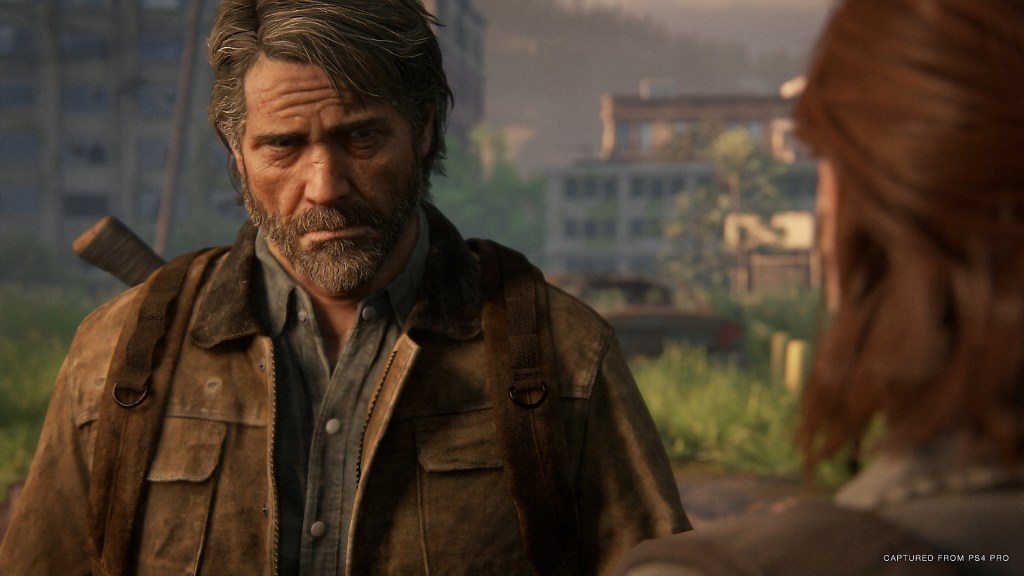
To start, I’d like to address the rampaging elephant in the room: the unnecessary and insulting murder of gaming’s favorite dad, Joel Miller. When I initially played the game, although a part of my soul cracked when I witnessed the heinous crime, I did not believe it detracted from the overall plot. Ellie needed a driving force that would allow her to seek vengeance at any cost, and the death of Joel most certainly accomplished it. However, this was the largest gamble ND took with the narrative, and gambles like this NEED to pay off. This one, regrettably, did not in the absolute slightest. After 26 and a half hours of playtime, I finally reached the coast of Santa Barbara to find a weakened Abby on death’s door. After cutting her down from the torture pillar, I was incredibly nervous. Why was Ellie letting her go, surely she didn’t take two trips across the country for nothing? But then, at the end, Ellie forces Abby to fight her, and after a grueling battle you at last have her at your mercy; viciously drowning her in the shallows of the Pacific Ocean. I was talking out loud to my TV “Yes, finally! You thought I would just forget what you did?” along with a wide variety of obscenities and insults. In this moment, I was beyond satisfied. I didn’t understand why the game got all of this “unwarranted” hate, I was witnessing the best possible ending for the story they were telling. Then, in quite possibly the worst decision in writing I’ve ever seen, Ellie gets off of her. She let’s her leave Santa Barbara. She let’s her live. Now this next sentence is addressed to Naughty Dog and more specifically the “director” Neil Druckman in particular: One, are you out of your minds and two, did you ever take a creative writing class in school? I believe the honest answers would be yes and then no, because this is the most ludicrous and forced absurdity I’ve ever seen implemented into a supposed “masterpiece” of a videogame. Abby had to die for the story to succeed, it’s that simple. She savagely murdered the main protagonist of TLOU1 (Ellie’s adoptive father), and for what? She killed Jessie (Ellie’s best friend), crippled Tommy (Ellie’s adoptive uncle), and beat a pregnant Dina (Ellie’s girlfriend and then later wife) halfway to hell…and for what? I’m supposed to believe that after everything and everyone Abby took from Ellie, the two treks across America there and back again, she just forgives her? That would be akin to Obi-Wan Kenobi saying to Emperor Palpatine “Yeah, you killed mostly everyone in my order, destroyed the foundations of everything I believe in, and have always plotted my downfall along with turning my brother to evil, but I forgive you Sheev”. It just doesn’t make any sense. Any human being, no matter how morally just, who has suffered immense loss such as Ellie at the hands of one individual would never forgive said individual, let alone allow them to live when they’re at your complete mercy. From my perspective, it seems like a genuine insult from the post-Uncharted 4 team at Naughty Dog to the fans of the original TLOU by leaving Joel unavenged. It simply does not make the slightest bit of sense, and made me feel completely unsatisfied. It doesn’t matter how fantastic a videogame, book, or movie may be, if there isn’t a satisfying resolution (especially when you make huge gambles like killing off your main character), the entirety of the story is worthless. If there’s no payoff, no fitting conclusion, then may I ask what the point of it even was? Now I know what the ND fan army is going to counter this with, “But the cycle of violence was broken, therefore it’s a fitting resolution as that was the theme of the story. You may not like it, but that’s the way the narrative was supposed to go”. Well to start, that’s verifiably false as for fifty percent of the game’s development, Abby was supposed to die. Not only that, but Abby is not a likable character, nor a good person, as she continues to perpetuate this “cycle of violence” well past her initial murder of Joel. This “grand artistic expression” of an ending is nothing more than a cheap cop out. She didn’t deserve to survive, even for Lev’s sake, as I’ll outline now.
The Abby Problem

As mentioned in our previous TLOU2 TGP article, the community has discovered that the original game was supposed to be played entirely as Ellie, due to concept art showing Ellie in segments of the game where you play as Abby. I just wanted to lay this groundwork to show how her character was rushed and then poorly utilized, as to give more background as to why she’s so unlikable. You play as her in an early part of the game, hunting down someone who is obviously Joel if you can pick up on the not so subtle hints Abby and Owen drop in their dialogue. Now, as someone who had no knowledge of any leaks, what came next was a brutal shock. Joel dying within the first two hours made me irreversibly hate Abby, and it was a true mistake on ND’s part for implementing that twist so early. After that, I could never sympathize with her again. There was only one instance where I came close to understanding her plight, as her father was murdered at the start of her half of the game. My father passed when I was extremely young as well, and in that moment I did feel her pain; and Naughty Dog I commend you for that. However, after that ND, you completely lost me. Not only does she kill Joel in a unnecessary and evil fashion (as he made her father’s death quick), she’s doing it out of pure revenge, whereas Joel committed his violence out of protection for someone he loved. Not only that, but if the Fireflies would have just told Ellie that she would die during surgery, she would’ve agreed to it and talked Joel down, resulting in no bloodshed and a cure. Due to this lack of understanding (pushed heavily by Abby’s father and reinforced by Abby herself), they just go for it without telling Ellie, setting Joel off. Therefore Joel’s actions, although while still wrong, is more justified than Joel’s murder. So, in a sense, Abby started the cycle of violence by seeking revenge and offensive violence first, and even continued to show that she was not a good person even after the fact. While she does save two children (only because they saved her life first), she massacres many WLF members who once fought alongside her in the process. Now, some may say it was out of self defense, but Abby (now a deserter and traitor), Lev, and Yara drew first blood by killing Isaac, the leader of the WLF, and was the provocation for them hunting Abby and her child cronies. An army doesn’t let their general go unavenged, just like a daughter shouldn’t allow her father to be, but I’ve already discussed that. There certainly were avenues to avoid that bloodshed, but Abby jumped straight to the gun. Besides her acts of unjustified violence, additionally she lacks moral fortitude. This is shown as she lies down with her ex, Owen, even though he is currently taken and expecting a child. Both parties are to blame here as it takes two to tango, but Abby is still at fault all the same. After experiencing all of this, once you reach the theater as Abby where Ellie is hiding out, they force you to fight Ellie as her, which I did not want to do whatsoever. Over the course of her story, they try to slightly turn you against Ellie in certain parts by trying to get the player to sympathize with Abby and her friends, but that never happens due to the aforementioned murder of Joel among other poor writing decisions/unconvincing dialogue. In fact, I let Ellie kill me at first because that’s the way I’d want it to go. They tried to push this new, invasive character too much, and if you never played the first game, sure it might work. But majority of people who play a direct sequel to a game have played the original, and that holds true to TLOU just like it does to anything else. To view both games as a complete story, only the first half remains quality. Abby’s character and progression of violence as a whole warrants her lack of survival, and yet they still let her live. Why, so that Lev would have someone with her? Why would Ellie care about that, regardless if she can relate to the child? It’s the same kid that put an arrow into her Uncle, leaving him crippled. And yes, Lev did tell Abby to stop before she killed a pregnant Dina (which, by the way, makes Abby a great role model and likable character, right ND? Especially since when Ellie killed Mel she had no idea of the pregnancy, and was visibly sickened when she found out. What did Abby say when she found out Dina was pregnant, with her blade to Dina’s throat? Oh yeah, that’s right: “Good.”), but Lev’s the one who led Abby to them in the first place so…yeah, I don’t have much sympathy for her either. If this was the first TLOU, this all very well could have theoretically worked. However, it’s not, and the blurry line between right and wrong that Naughty Dog tried to craft fell flat on its face and came out crystal clear. By the ending of the game, not only has Abby shown she lacks character and morality/ethics, but has already clearly painted herself as the villain by viciously killing our beloved Joel Miller with the support of all of her friends, which immediately justifies Ellie’s vengeance to the player. Mel, Owen’s pregnant girlfriend, said it best: “You’re a terrible person Abby. You always have been”.
Conclusion
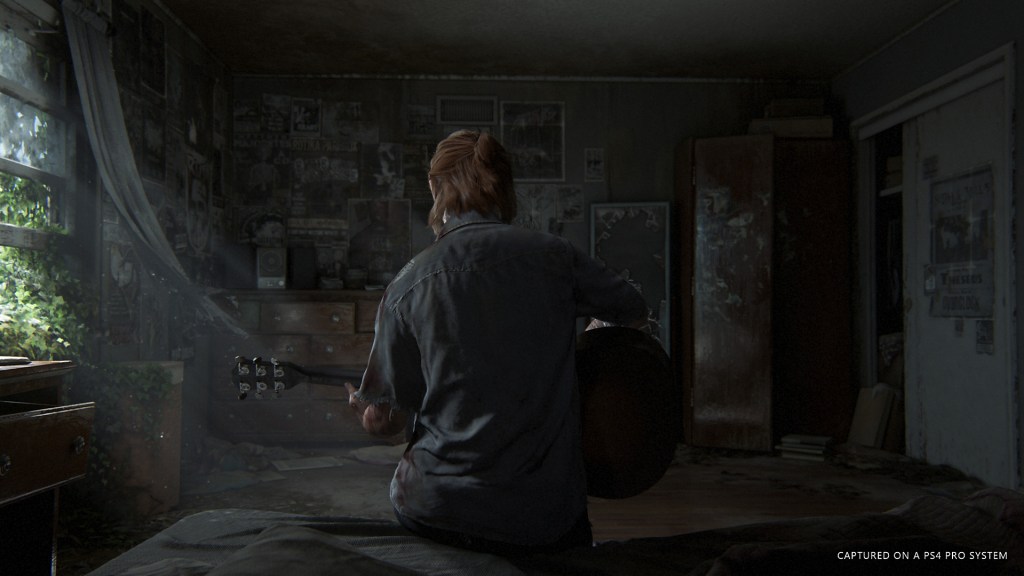
Don’t worry, I’m not going to pull a Naughty Dog and leave you feeling empty inside, as this exposé will have a satisfying resolution. Although, there isn’t much more to say, but I just need to once again express how deeply disappointed I am with this game, as seven years of waiting amounted to no pay off whatsoever. Whether you’re writing an essay for school, a screenplay in a coffee shop, or a storyline for a videogame, you most certainly are allowed to take risks with your creation. In fact, I’d even wager that narrative gambles are necessary to capture the audience’s attention and insure they stick around for the entire time. However, in doing so, you need said risks to pay off. Without a satisfying resolution, it doesn’t matter how incredible the rest of the narrative is; the story is unfinished, the audience is unfulfilled. They feel as if their time was wasted, there was no fitting conclusion that can ease their mind to the controversial decisions made by the narrative. Honestly, I would rather have never played TLOU2, and kept the story of the first game unsoiled. Therefore, it is my argument that the narrative of The Last of Us 2 is, undoubtedly, worthless.


 The Game Preview